Count the shoppers who actually saw your in-store screen, with one device
When advertisers ask how many people saw it, the answer has to be people who looked, not people who walked by. Here is what changed now that 3D pose judgment runs inside a single in-store device.
Teams that run in-store screens and promotional displays hear the same question from advertisers and brands: so how many people saw it? Answer with the number of people who walked by and advertisers will not take it at face value. Answer with sales and you have to wait until the promotion ends.
The number advertisers want is how many people actually looked at the screen or shelf. We call that attention, and the number of people who walked past exposure. If 2,000 people pass an endcap screen in a day but 300 actually look at it, the number that matters to the advertiser is 300, not 2,000.
Where teams get stuck
- The numbers are weak. Exposure alone makes it hard for in-store media to prove results the way online ads can
- Promotion results come late. Seeing whether a display change worked through sales means waiting until the promotion ends
- Measuring precisely is costly. Telling who actually looked usually means adding devices or sending video to a server
What one device tells you
We answer that question with a small camera and one analysis device placed by the screen or shelf. The device rebuilds each person's joint positions and head and gaze direction in 3D and judges whether they really looked. It can tell when the body faces the screen but the eyes are on a phone, or the body is turned away but the eyes are on the shelf. It also measures the distance between camera and person, so someone brushing past and someone looking from a few steps away are counted separately.
So one device gives you several numbers at once:
- People who walked by (exposure) and people who actually looked (attention)
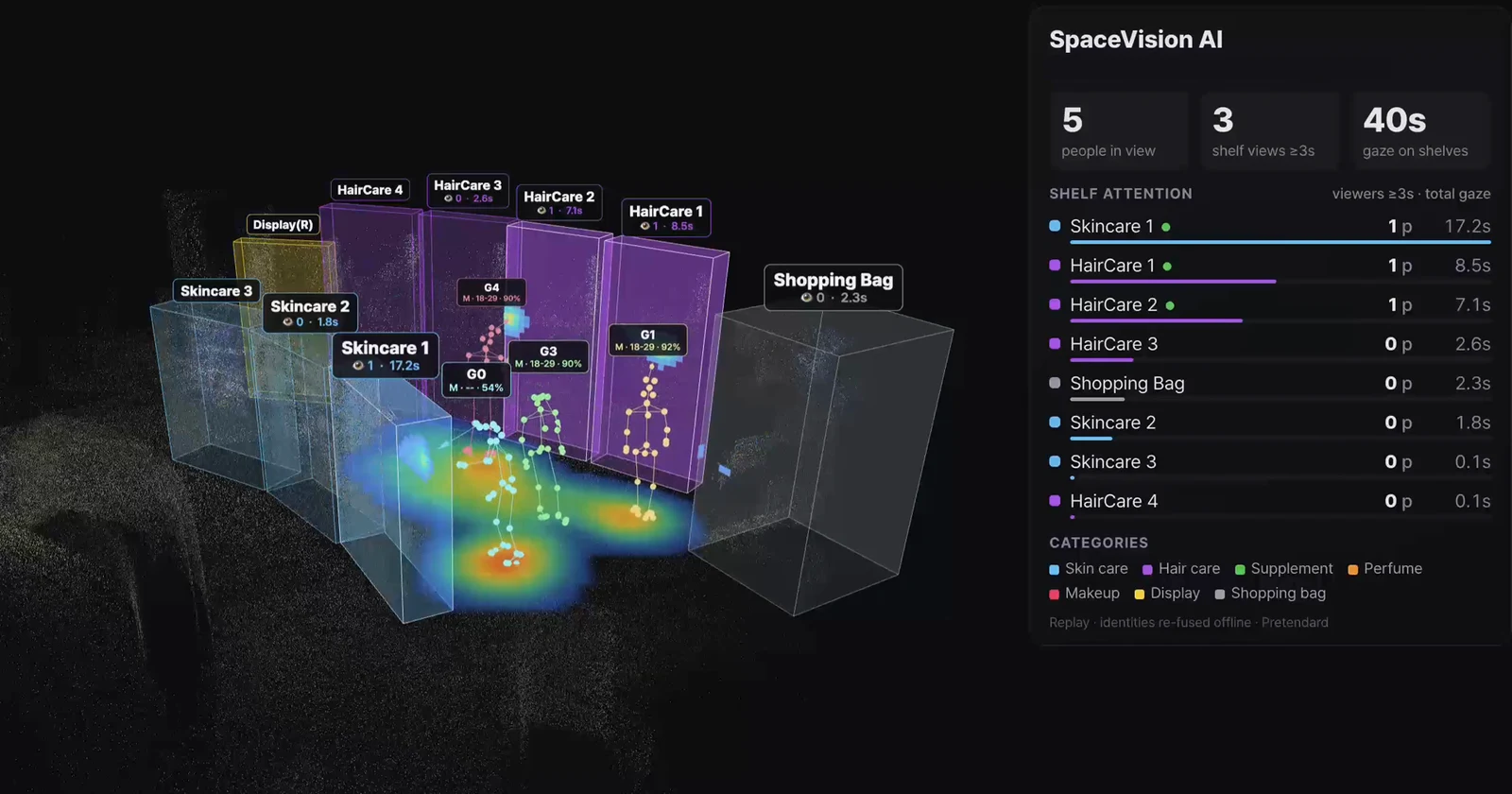
- Viewers and viewing time per shelf or screen
- Where people lingered in the store
Why one device is now enough
3D pose judgment is heavy. When we first deployed it, it used 70 to 80% of the device's resources. Left as is, it would have meant a more powerful device or sending the work to a server.
Our ML team moved most of that work onto a dedicated AI chip inside the device, which made processing faster. Attention is now judged inside a single in-store device, which can also handle content playback and data collection alongside it more easily.
What changes for your team
- Report people who looked. Add attention and viewing time to exposure, so advertisers get numbers they can check
- See promotion results before sales. Check how viewers and viewing time change after a display change, while the promotion is still running
- Start without adding devices. With no heavy work sent to a server, each store can start with one small device
See it
A demo of a drugstore in Korea rebuilt in 3D, following shoppers' skeletons and gaze direction. The heatmap shows where people lingered, and the panel on the right adds up viewers and attention time per shelf.
FAQ
What numbers can I show advertisers?
For each screen or shelf: people who walked by (exposure), people who actually looked (attention), and how long they looked. Grouped over a campaign period, that becomes "this many people passed, and this many of them looked, for this long."
When can I see promotion results?
Viewers and viewing time start adding up the day you change the display. You can compare them with the period before the change and adjust the display or message while the promotion is still running.
Where should we start?
Start with the placement advertisers ask about most. Put a small camera and one analysis device at an endcap screen or promotional display where you need to show results, and measure exposure and attention together. That placement then has numbers you can bring to advertisers.
How is shopper privacy handled?
Camera video is processed only inside the analysis device in the store. Only anonymous counts, such as how many people passed and how many looked at each screen or shelf, go to the server. The numbers you share with advertisers contain only counts and viewing time.
If you want to show advertisers the people who actually looked, not just the ones who walked by, start with one in-store device. Request a demo and we will show you.