How we protect privacy
SpaceVision is anonymous audience measurement, closer to a digital tally that counts people than to CCTV. This page explains what our devices see, what leaves them, and how that maps to the GDPR, the EU AI Act, and Korea's PIPA.
7 records · 0 images · 0 faces
Video never leaves the device
The AI Box analyzes each frame in memory and discards it within milliseconds. Frames are not written to disk or transmitted. The device sends measurement records instead.
The device sends measurement records and does not transmit the camera frame.
Only the numbers move forward
The on-site AI Box keeps visual data inside the device. It sends non-biometric event records to the cloud for aggregation and dashboard reporting.
Built without video storage or identity tracking
The system does not create or transmit stored video, biometric templates, or identifiers for cross-visit tracking. The compliance pack below documents the engineering controls.

Video storage and identity tracking are excluded from the architecture
Frames are discarded from device memory in milliseconds. No video exists on disk, in transit, or in the cloud.
No facial recognition, no biometric templates. The system has no material to identify anyone with.
Anonymous tracks live within a single visit and then reset. There is structurally no way to connect yesterday's visitor to today's.
Only zone-level statistics leave the store, and no decision is ever made about an individual person.
The system knows someone is still here, never who came back
An anonymous visit is linked only long enough to measure movement and dwell. The system stores no video or identity and retains only the de-identified behavior data needed for analysis.
Anonymous linkage data is deleted automatically after a short period. Only aggregated results are used for reporting.
- Not facial recognition, gait recognition, or body-shape identification
- No persistent biometric templates, no matching databases
- No matching across sessions, days, sites, or customers
The system is not designed to identify a visitor across sessions, days, sites, customers, or tenants.
The system records presence, location, dwell, and attention for the current visit without creating an identity record.
Answering what the law asks
Three regulators ask different questions. One architectural fact answers all three: what leaves the store is anonymous, aggregated measurement, not personal information.
The reporting layer receives anonymous, aggregated measurements
Who is the controller, and what is the legal basis?
You remain the Data Controller; SpaceVision acts as your Data Processor under an Art. 28 DPA. Under the EU AI Act, SpaceVision is the Provider and you are the Deployer, and we supply the documentation both roles need.
Dashboards and KPIs are aggregated statistics designed to be anonymous (Recital 26). Underlying event records are non-biometric and session-scoped, and we conservatively handle them under GDPR-grade controls until aggregation.
Deployments typically rest on legitimate interests (Art. 6(1)(f)), supported by a documented balancing test. No special-category data (Art. 9) is processed under the intended use, and no automated individual decisions (Art. 22) are made.
EU hosting is available (AWS Frankfurt, eu-central-1). Where transfers apply, EU Standard Contractual Clauses are in place, and Korea holds an EU adequacy decision (in force since 2021). No video or biometric data exists to transfer at all.
If a security incident is ever confirmed, we notify you within 24 hours, supporting your own 72-hour notification duty as controller.
What risk tier is this, and does it use any prohibited techniques?
SpaceVision is an AI system in scope of Regulation (EU) 2024/1689, assessed as Limited Risk for its documented intended use. It practices none of the prohibited techniques of Article 5, and falls in no high-risk category: it is not a safety component and never uniquely identifies a person.
“SpaceVision AI is intended exclusively for anonymous audience measurement and content effectiveness analytics in retail stores, exhibitions, events, and out-of-home digital signage environments.”
No face databases, no scraping, no matching. By design, the system cannot answer the question of who a person is.
Attention is head-pose-based gaze estimation: is someone looking at the screen, and for how long. It does not infer feelings or intent.
Only coarse gender and age-band estimates for audience statistics. Race, ethnicity, beliefs, or health are never inferred or emitted.
No unique identification of any person, in real time or retrospectively.
What does apply is Article 50 transparency: visitors should know an AI system is measuring the space. We ship multilingual in-store notice templates and operator training materials (Art. 4 AI literacy) with every deployment.
Is what leaves the country personal information?
The architecture was reviewed against Korea's Personal Information Protection Act (PIPA), with compliance confirmed by legal opinion. The basis is the structure this page keeps repeating: what leaves the store is aggregated, anonymized measurement data, not personal information.
What you see, what you get
The dashboard reports aggregate statistics
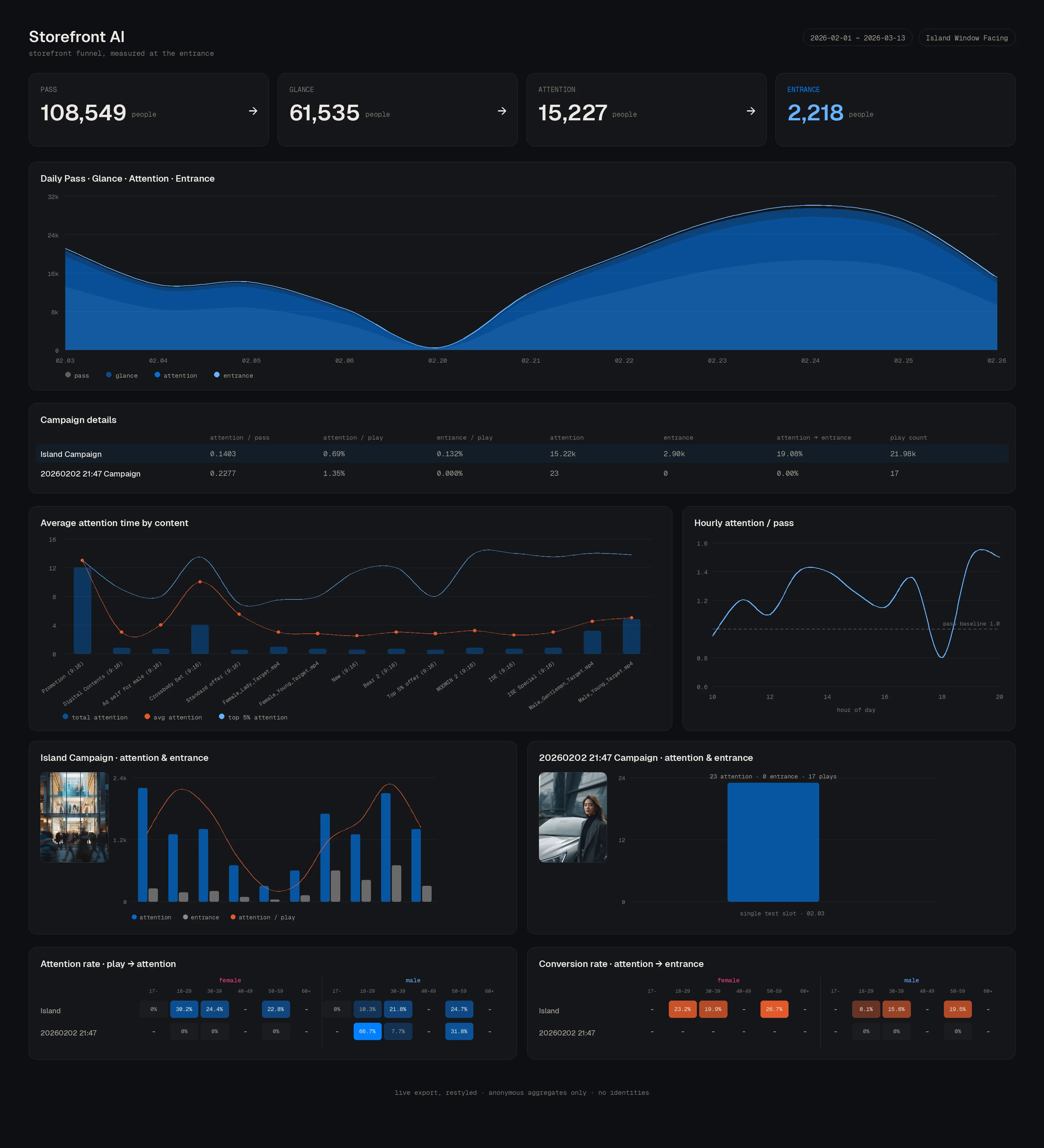
- ·pass, glance, and attention counts per zone and hour
- ·walk-in conversion and average dwell time
- ·audience mix as coarse estimates: an age band like “30–39”, never a birthdate
- ·trends across days, campaigns, and locations
Reports are grouped by zone, hour, audience, campaign, and location. The product does not provide person-level records.
- ✕names or contact details
- ✕account or loyalty identifiers
- ✕visitor IP addresses
- ✕images or image hashes
- ✕facial or biometric templates
Documents provided for privacy and legal review
A DPIA template for the EU (with a UK GDPR addendum) plus DPO-led support sessions to help your privacy team complete the assessment.
A standard DPA meeting Art. 28(3) GDPR, with EU Standard Contractual Clauses where transfers apply.
A multilingual notice template (EN · DE · FR · NL · IT · ES) for store entrances, supporting your EU AI Act Art. 50 and GDPR Art. 13 duties.
High-level architecture, security architecture, and model documentation available on request under NDA, plus a disclosed sub-processor list.
Our Data Protection Officer answers directly, and detailed documentation is available under NDA.