In-store signage ads: Pass count vs Attention count
What changes when you measure offline ads by how many people passed a screen versus how many actually paid attention, and how attention is detected.

Ask how an in-store digital signage campaign performed and the answer is usually daily foot traffic: the number of people who passed the screen. We call this the Pass count. Online ads count impressions and clicks separately. Offline ads still tend to treat passing and paying attention as one number.
This post covers how the Pass count and the Attention count differ, how attention is detected, and what you can change once you have both.
What the Pass count alone misses
The Pass count is the number of people who moved near the screen. It says nothing about whether they looked at it. The same 1,000 passers can produce very different Attention counts depending on screen position, height and creative, and the Pass count alone hides that difference.
- Advertisers cannot compare which store or time slot actually earned attention
- Retailers selling the media end up pricing a well-placed screen and a poorly placed one the same way
- Creative teams cannot tell which video held people's eyes, so the next round has nothing to build on
How attention is detected
The Attention count is the number of people who turned their gaze to the screen and held it there. We judge it from body posture and head and gaze direction. Even from side or rear angles where the face is barely visible to the camera, gaze direction is estimated from the person's full 3D posture.
The calculation runs on a small device installed near the screen, not on a server.
Video is processed on that device, and the system is designed so that only anonymous, aggregated counts are sent to the server. Gender and age are aggregate estimates, not information that identifies anyone.
Five stages from Pass to Dwell
Attention is not the end point. We count the path from passing the screen to time spent in store as stages, so you can see where people drop off and what to fix.
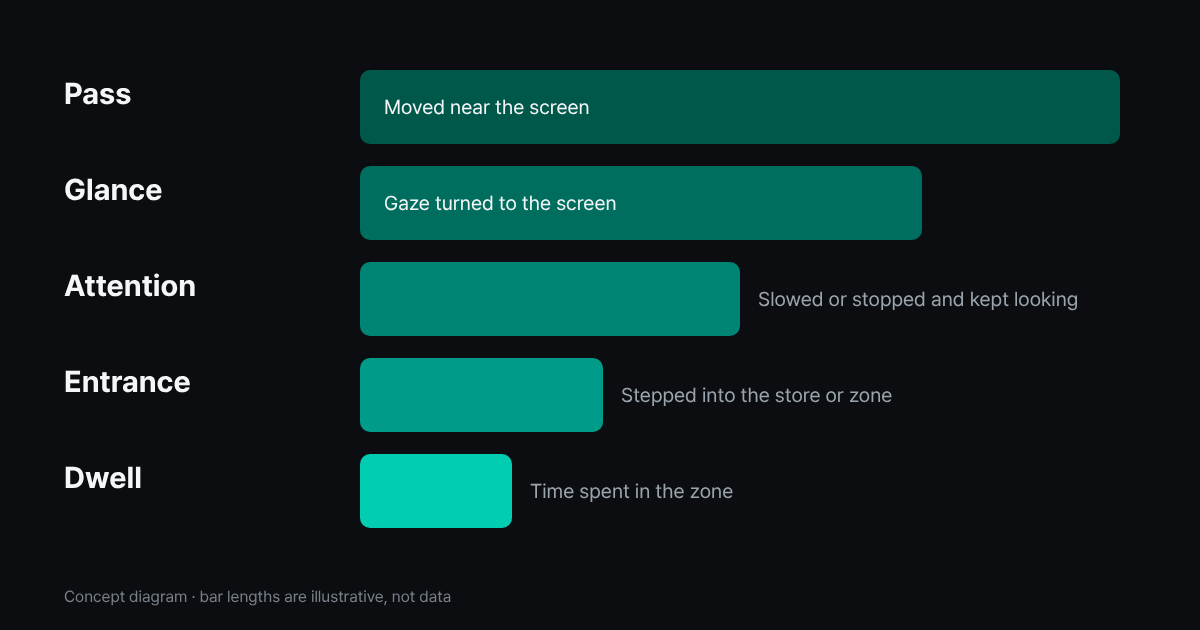
- Pass: people who moved near the screen. The baseline for every rate
- Glance: people whose gaze turned toward the screen. Glance rate = Glance ÷ Pass
- Attention: people who slowed or stopped and kept looking. The time threshold is set per site. Attention rate = Attention ÷ Glance
- Entrance: people who stepped into the store or zone. Entrance rate = Entrance ÷ Attention
- Dwell: time spent inside the zone
What these numbers let you change
- Sell inventory on attention. Show advertisers the Attention count alongside the Pass count when you propose a placement
- Fix screen placement. A high Pass count with a low Glance rate points to position or height before creative
- Compare creative. If people glance at the screen but the Attention rate stays low, the creative is not holding them. Compare attention by creative and play the stronger ones more often
Frequently asked questions
Do we still need the Pass count?
Yes. The Pass count is the baseline for every rate. On its own it cannot tell you whether an ad earned attention, so read it together with the Attention count.
Does the camera identify individuals?
No. The system is designed so raw video does not leave the site, and only anonymous counts, such as how many people passed and how many paid attention, are sent to the server. It does not identify specific people or track repeat visitors.
Does it work with signage that is already installed?
Yes. A camera and a small analysis device are installed near the existing screen to take the measurements.
Advertisers care less about how many people passed and more about how many paid attention. Offline ads can be discussed in that number too.